
How Do I Find a Therapist?
Don't know how to get started looking for a therapist? Here are some tips to guide you towards better mental health. Specific resources in Howard County, Maryland (especially Columbia and Ellicott City) included!
Susanna Sung, LCSW-C
10/22/20253 min read


It takes a lot of courage and strength to ask for help. Now that you know you want to see a therapist, how are you supposed to find one? What kind of clinician are you supposed to see? It can be really confusing. Spoiler alert: the therapist should be licensed! It’s important to see a licensed therapist because a license means they have shown a standard minimal competency level, and that there is a regulatory board that can help if there are ethical or other complaints. Licensed clinicians also must continue professional learning every year and prove this. Certifications do not provide this.
Next, what kind of mental health clinician should you see?
For medications, you would see one of these:
• A psychiatrist (a medical doctor: an MD or DO)
• Psychiatric-Mental Health Nurse Practitioners (PMHNP)
• Your primary care physician (PCP)
• Your pediatrician for your child
For talk therapy, you would see:
• A licensed clinical social worker (the initials vary by state and level of licensure, but common ones are LCSW-C, LICSW, LCSW)
• A licensed clinical professional counselors (LCPC)
• A licensed marriage and family therapists (LMFT)
• A psychologist (PhD). Psychologists also provide neuropsychological and other testing
• Pastoral Counseling is an option for some people who are seeking spiritual/religious
Inpatient vs Outpatient:
• Inpatient mental health care requires overnight stays in the hospital for circumstances that require such a level of safety and supervision
• Outpatient mental health care lets the person go home after their appointment(s)
Group vs Individual Sessions:
• Group sessions are with several people in the room or online. This setting tends to be for a shared experience and providing support to each other, or building skills.
• Individual sessions are personalized sessions with you and your therapist to talk about your specific concerns.
• Sometimes people benefit from participating in both formats at the same time.
Your specific circumstances may benefit from medication and talk therapy, or just talk therapy. Talk to your therapist or doctor about what might be best for you. Remember that you can always start medication and/or therapy, and it does not mean it’s forever.
How do you find a therapist?
• If you have health insurance, call them or look for their online directory. You can search for providers according to your preferences (virtual or in-person, location, demographics, etc.).
• You, or someone you live with may have access to their job’s Employee Assistance Program (EAP). EAP plans differ, but they generally provide a number of free counseling sessions with a licensed therapist for the employee, their family members, and people living in their household. Call the EAP to find out details.
• Your state and county (or local) governments have health departments. Do a search online for those services. For those living in Howard County, where my practice is located, you can find services here: And in the state of Maryland, you can find services here:
• Advocacy and support organizations like Mental Health America and National Alliance for the Mentally Ill. They have local chapters for you to call to ask for resources.
• Local crisis organizations. In Howard County, there is Grassroots.
• There are online directories including Psychology Today, Asian Mental Health Collective, Therapy for Black Girls, Therapy for Black Men, Therapy for Latinx, Open Path, National Queer and Trans Therapists of Color Network, and many others. For college students, there are online directories Thriving Campus and Welltrack Connet, as well as college campus health centers.
What do I look for in a therapist? Some questions to ask include:
• What experience do you have treating someone with my issue?
• How do you usually treat someone with my issue?
• How long do you expect treatment to last?
• What are your fees?
• Do you accept my insurance?
If you are in crisis, please call or text 988. This is the 988 Suicide & Crisis Lifeline and is available 24/7/365. Your conversations are free and confidential.
Susanna is a psychotherapist and founder of Thrive Fully, a therapy and consulting business providing therapy, mental health and wellness training, crisis response, program and evaluation development, and marketing expertise. She has over 30 years of clinical and research experience, and retired from the National Institute of Mental Health, National Institutes of Health. She is a keynote speaker at national conferences, a writer (Huffington Post!), live storyteller (Stoop, Listen To Your Mother, podcasts), drummer (in between gigs), and both a cat parent and human parent. Learn more here: www.linkedin.com/in/susannasung
Book a session, gig, or service at: Susanna@ThriveFullyTherapy.com

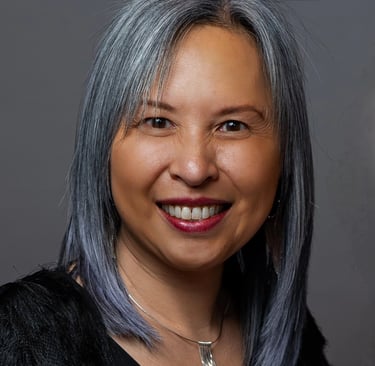
About the Author Susanna Sung, LCSW-C